Deliver safe, secure financial services with advanced geolocation
When it comes to financial transactions, your customers need to have full confidence in the safety and security of your offerings — or they’ll go elsewhere. Our accurate, real-time geolocation solutions are a critical tool for ensuring the security and compliance of financial services worldwide by verifying user location and combating fraud.

OVERVIEW
Comprehensive geolocation services for financial services compliance
Cybersecurity attacks and identity theft are constant threats for financial services companies today. This climate makes it imperative to maintain financial services compliance and protect sensitive data across every stage of a transaction. Our platform provides robust geolocation services that verify transaction locations and ensure fraud prevention in real-time — mitigating risks and protecting your hard-earned reputation.
Serving diverse use cases in the financial services sector

Transaction verification
Ensure every transaction is conducted from a verified location. Our comprehensive geolocation services support financial services compliance by confirming the legitimacy of each transaction and digital payment, reducing the risk of fraud and unauthorized access.

Risk management
Enhance your risk management strategies with precise, real-time location data. We help financial institutions identify and respond to suspicious activities swiftly, ensuring compliance and fraud prevention with regulatory requirements and protecting your assets and reputation.

AML (anti-money laundering) compliance
Support your AML efforts with accurate geolocation data that verifies the origins of transactions. Locance ensures financial services compliance by helping you effectively detect and prevent money laundering activities around the world.

Customer onboarding
Streamline the customer onboarding process by verifying the location of new clients. Our platform verifies that onboarding procedures meet compliance standards, reducing the risk of onboarding fraudulent or unauthorized accounts.

Cross-border transactions
Prevent unauthorized cross-border transactions with our advanced geolocation and anti-fraud tools. The Locance platform keeps financial activities compliant with regional regulations, protecting your institution from legal and financial risks.

eCommerce personalization
Improve the eCommerce customer experience by using location services to tailor how your brand engages them, from localized product recommendations and promotions to precise delivery times and address verification.
The business case for verified geolocation for compliance and KYC in financial services
In financial services, weak location controls don’t just create fraud exposure — they show up directly in fines, breach costs, and lost trust.
TRY OUT OUR API
Experience the power of our APIs
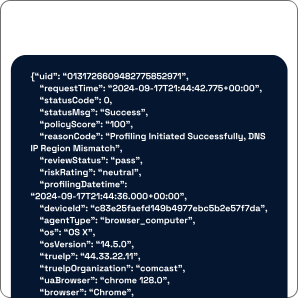
Get hands-on with Locance’s advanced location services by trying out our APIs today.

A customizable platform for your unique financial services needs
For financial services firms seeking advanced fraud prevention using geolocation technology, the Locance platform offers a suite of powerful services — including device profiling, geofencing, compliance, and geolocation — that seamlessly integrate into your applications, business processes, and workflows. These capabilities are enabled via our web service APIs, mobile app SDKs, and a SaaS Customer Portal for administration, reporting and analytics.
Whether your financial services business needs a plug-and-play or deeply customized solution, our battle-tested platform and highly experienced team are geared toward meeting your objectives to ensure financial services compliance. With over 10 years of real-world operating experience, our sole focus is to fulfill your critical business needs for long-term, sustainable success.
The Locance platform
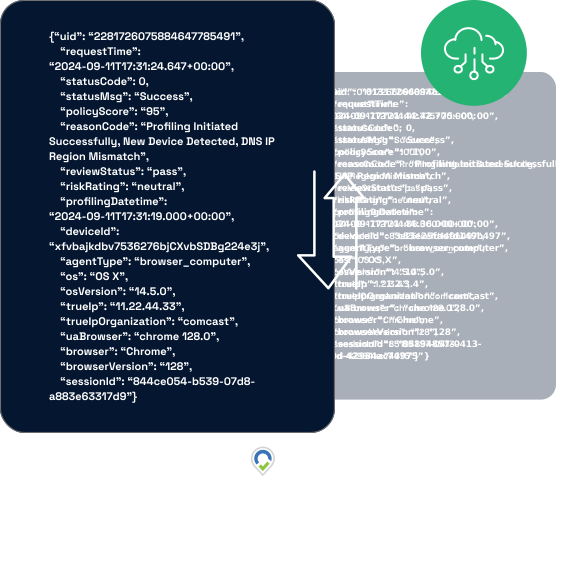
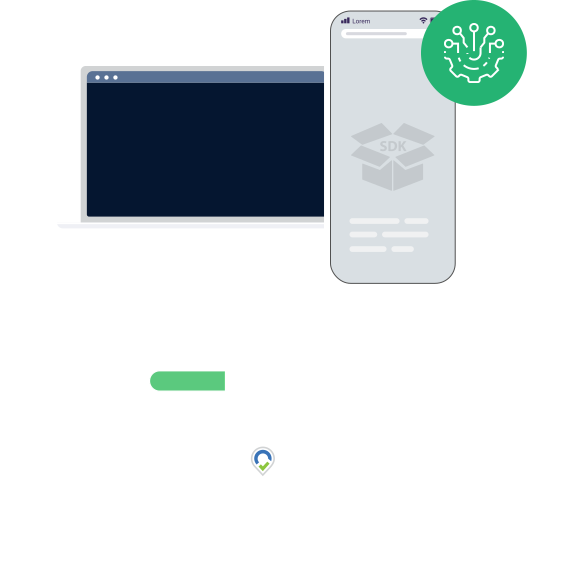
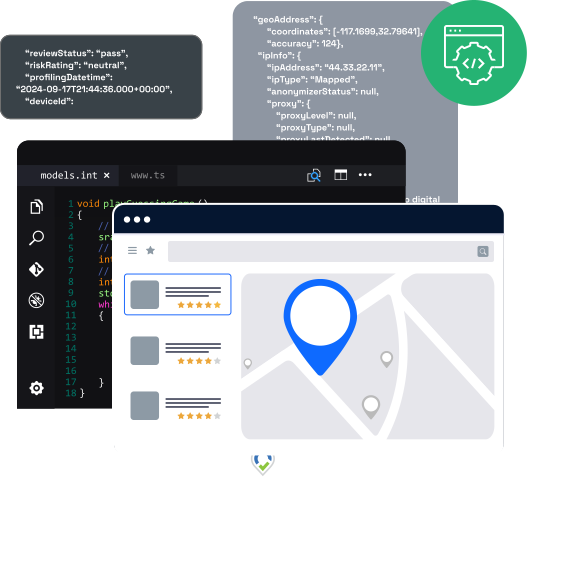
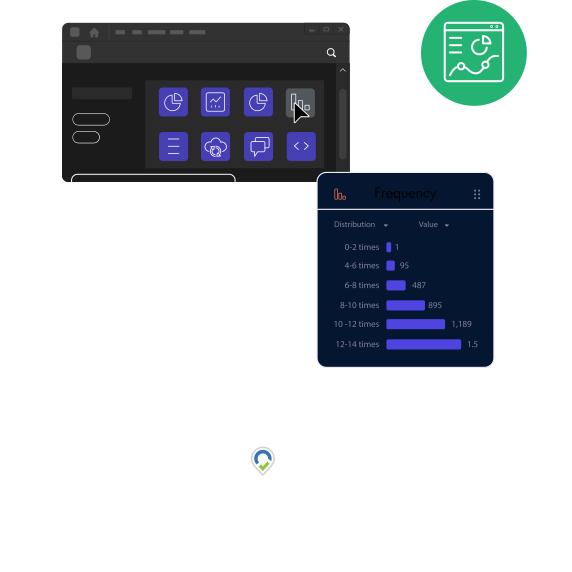
Highly configurable and flexible APIs adapt to your specific financial services use cases, solving your most demanding geolocation and compliance challenges.
- Multi-source location: Use our location APIs to quickly and reliably locate any type of device across various environments including mobile, Wi-Fi, and fixed connections. Get coordinates and street address details with built-in reverse geocoding.
- Device profiling: Our device profiling APIs work to identify risky device configurations and behaviors, improving security and protecting against digital and human threats.
- Geofencing: With our Smart Zone geofencing APIs, you can use pre-configured or custom virtual boundaries to trigger actions, ensure compliance, and improve financial services user experiences.
- Geolocation compliance: Meet regulatory requirements and counter cyber threats confidently with our multi-faceted compliance APIs configured to your specific needs for geographically controlled access to your content, applications, or services and protection against threats to your digital transactions.
Easily integrate the power of our advanced location and device profiling APIs into your iOS and Android apps with our platform-optimized SDKs.
Our lightweight JavaScript SDK enables smooth integration of Locance’s geolocation, device profiling, and geofencing capabilities directly into your browser-based applications for financial services compliance.
Access our SaaS web portal for developer resources, administrative tools and interactive reporting delivering data insights, operating metrics, and drilling down into granular transaction details.
Unlock the value of verified
geolocationfor your business

Request a Demo
Geolocation insights & expertise



Geolocation for Financial Services FAQs
How does Locance’s geolocation solution integrate with our existing systems?
Locance integrates through cloud-based APIs, mobile SDKs for iOS and Android, and a lightweight JavaScript toolkit for browser-based applications, so you can add location verification to login, transaction, or onboarding flows without requiring your end users to download anything. Our SaaS customer portal gives your team administrative controls, reporting, and analytics. Whether you need a plug-and-play deployment or a deeply customized integration, our team works with you to fit the solution into your existing fraud detection and compliance workflows, complementing what you already have instead of replacing it. Because our LIVE KYC identity verification services run on the same Location & Identity Verification Engine, they integrate the same way: as part of your onboarding and user validation flows.
How does Locance help our company detect fraudulent transactions?
Locance combines IP location and connection analysis, browser- and app-based location, and device profiling to build a complete picture of where a transaction is really coming from. Each layer catches something the others might miss: IP intelligence flags proxies and anonymizers, device profiling detects VPNs, virtual machines, and tampered devices, and behavioral and velocity analysis surfaces bot activity or physically impossible travel patterns. When a discrepancy shows up, such as a device located in a different region than the account’s stated address, your system can trigger step-up authentication or block the transaction outright. Whether verifying the location behind a transaction or reinforcing identity checks at login, these layers help guard against risks like account takeover, which resulted in more than $15.6 billion in reported U.S. losses in 2024. That’s up from $12.7 billion in 2023, with reports rising over 36% year-over-year, according to Suspicious Activity Report filings tracked by the Federal Reserve.
What geolocation solutions are available to mobile banking app providers?
Our iOS and Android SDKs bring location verification and device profiling directly into your mobile banking app, with users prompted for consent through the same OS-level privacy controls they already know. If they decline, you can block the transaction or fall back to step-up authentication. GPS, Wi-Fi, and cell tower location signals feed into the location result, providing accuracy from a few meters to a few hundred meters depending on the signals detected by the device. Our JavaScript toolkits cover web-based mobile use cases in the same way.
Are user IP identification and spoof detection part of Locance’s geolocation process?
Yes. IP location and connection analysis is one of the core layers of our platform. We leverage a network with visibility into more than 99.9999% of active IPv4 and IPv6 addresses, identifying the geographic origin of a connection along with details like ISP, connection type, and whether a proxy, VPN, or other anonymizer is masking the true location. We don’t rely on IP location alone; it’s paired with device profiling and browser- or app-based location, so spoofing attempts that slip past one method can be caught by another.
What location verification solutions are available for financial services providers?
Financial services firms can draw on four complementary verification methods: IP location and intelligence, browser-based location, mobile app-based location, and device profiling with anti-spoofing checks. That layered approach matters: banking absorbed 83% of API endpoint attacks in 2025, and 96% of financial services leaders reported at least one API security incident in the prior 12 months. This means that no single checkpoint is enough on its own. Our geolocation compliance APIs and Smart Zone geofencing add another layer of control, letting you define allowed service areas or exclusion zones, restrict cross-border activity, and tailor validation rules to jurisdictions with stricter regulatory requirements. These pieces are designed to work together as a layered defense rather than as standalone tools.
How can geolocation services combat financial fraud?
U.S. consumers reported losing more than $12.5 billion to fraud in 2024, a 25% increase over the prior year, with more than 1.1 million reports of identity theft logged through the FTC’s IdentityTheft.gov website. Geolocation helps close that gap by verifying that the person behind a transaction is actually where their account activity says they should be. Layering IP intelligence, device profiling, behavioral analytics, and real-time location data helps catch common fraud tactics like VPNs, proxies, spoofed GPS coordinates, and remote access tools before a transaction clears, reducing the risk of discovering fraud only after the damage is done.
How does Locance’s geolocation solution help protect online transactions and ensure compliance?
Every transaction can be checked against geofence rules, location confidence scores, and device risk signals in real time. If a user falls outside an approved service area, uses a known high-risk connection, or shows signs of tampering, the transaction can be flagged, blocked, or routed to additional verification. The stakes are real: FinCEN assessed a $140 million civil money penalty against USAA Federal Savings Bank for willfully failing to maintain an AML program that met Bank Secrecy Act requirements. Locance gives you a defensible, auditable process for meeting requirements under regulations like the Bank Secrecy Act and the Anti-Money Laundering Act, plus the reporting and analytics your compliance team needs to document how each decision was made.
How can user location verification ensure regulatory compliance for my financial products?
Regulatory expectations vary by jurisdiction, and enforcement has real teeth: in July 2025, OFAC settled with Interactive Brokers for $11,832,136 over more than 12,000 apparent sanctions violations tied to serving customers in sanctioned jurisdictions. Some states also impose additional fraud detection and compliance requirements on top of federal rules like the BSA and AMLA. Locance’s compliance APIs and rules engine include geofences and validation logic configurable for those requirements: restricting access only to certain states, blocking transactions from high-risk countries, or applying enhanced scrutiny based on transaction type, value, point of origination. Because the rules are configurable instead of hardcoded, they can be adjusted as regulations evolve without you having to rebuild your fraud detection stack.
What methods does Locance use to detect suspicious or fraudulent activity?
Synthetic identity fraud is a growing blind spot: TransUnion found that 8.3% of all digital account-creation attempts in 2025 were suspected of fraud, the highest-risk stage across the customer lifecycle. This is part of why Locance layers several detection methods together through its Location & Identity Verification Engine. IP intelligence flags proxies and anonymizers. Browser- and app-based location provides real-time GPS, Wi-Fi, and cell tower verification. Device profiling supports risk scoring, persistent device fingerprinting, velocity analysis, and behavioral analytics; reviewing signals such as system and software versions, connection type, and mouse or keyboard usage patterns to help distinguish a legitimate customer from a bot or impostor. Each method assigns its own confidence and risk scores, so your fraud rules can weigh multiple signals instead of depending on a single data point.